
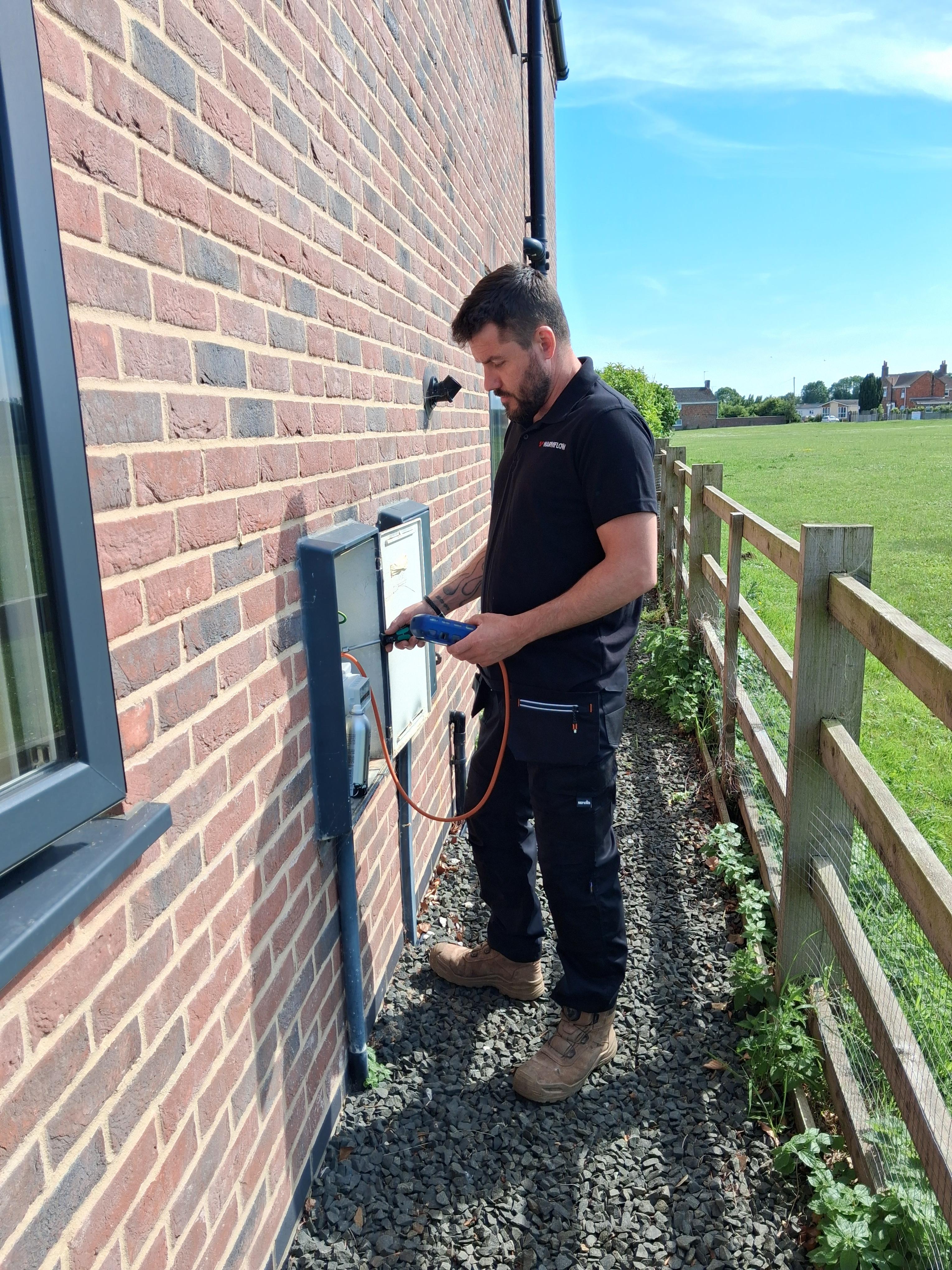
Safety first
None of the checks below involve taking the boiler casing off. Never open up a gas, LPG or oil boiler yourself. Leave anything inside the case to a qualified engineer.
Turn off the gas at the meter if you can, open doors and windows, do not use light switches or anything that could cause a spark, and get everyone outside. Call the National Gas Emergency number on 0800 111 999. It is free and open 24 hours a day.
1. Is the fuel getting through?
It sounds obvious, but it is the first thing to rule out. On mains gas, check whether your hob works. If it does not, the problem is your supply, not the boiler. On a prepayment meter, check there is credit.
On oil, check the level on your tank gauge. A tank that has run very low can draw sludge from the bottom into the fuel line, which is why a boiler sometimes stops shortly after a top-up. On LPG, check the tank level and, in a hard frost, whether the regulator on the tank has iced up.
2. Check the boiler pressure
Most combi and system boilers have a pressure gauge on the front. When the system is cold it should usually sit somewhere between 1 and 1.5 bar. If it has dropped close to zero, the boiler will lock out to protect itself.
Many boilers have a filling loop underneath for topping the pressure back up. Your boiler manual will show you how. If you find yourself topping up every few days, there is a leak somewhere in the system and it is worth getting it looked at.
3. Look at the thermostat and timer
Turn the room thermostat up a few degrees above the room temperature and listen for the boiler to fire. Wireless thermostats run on batteries, and flat batteries are one of the most common causes of a "broken" boiler.
Check the timer too. A power cut can reset it, and the clocks changing in spring and autumn can leave it running at the wrong times. The clocks go back on Sunday 25 October 2026, so it is worth checking yours that weekend.
4. Reset the boiler, once
Most boilers show a fault code and have a reset button. It is fine to press reset once. If the boiler fires up and stays on, it may have been a one-off. If it locks out again, stop there. Repeatedly resetting a boiler that keeps locking out can make a fault worse, and the fault code itself is useful for me to know when you call.
5. Has the condensate pipe frozen?
Modern condensing boilers have a plastic pipe that carries water away to a drain outside. In a cold snap it can freeze, the water backs up and the boiler shuts down. You might hear gurgling, or see a fault code that mentions the condensate.
If the pipe runs outside, pour warm water (not boiling) slowly along it, or hold a hot water bottle against it, then reset the boiler. Exposed pipes on homes out on the open Fens are especially prone to this in January and February.
6. Check the power
Look for a display or lights on the boiler. If it is completely dead, check the fused spur switch next to it (often on the wall nearby) and your fuse board for a tripped switch. If the switch trips again when you reset it, leave it off and call an engineer.
7. Bleed any cold radiators
If the boiler is running but some radiators are cold at the top, they probably have air in them. Turn the heating off, use a radiator key to open the bleed valve slowly until water appears, then close it. Check the boiler pressure afterwards, as bleeding radiators can drop it.
Radiators that are cold at the bottom are a different story. That usually means sludge has built up in the system, and bleeding will not help. It needs an engineer to clean the system out.
8. When to stop and call an engineer
Call a qualified engineer if any of these apply:
- ✓The boiler locks out again after one reset
- ✓You can see water leaking from the boiler or pipework
- ✓There is a burning smell, or soot or staining around the boiler
- ✓The pilot light or flame is yellow or orange rather than crisp blue
- ✓You are topping up the pressure every few days
- ✓The fuse or trip switch keeps going
Stopping it happening again
Most of the breakdowns I see in winter come from boilers that have missed a service or two. An annual service catches worn parts, blocked condensate traps and failing components before they leave you without heat. Customers on my service plans also get priority slots when something does go wrong, which matters most in the first cold week of the year when everybody's heating is under strain.
Covering Boston and South Lincolnshire
If you have worked through the checks and the boiler is still not playing ball, I cover breakdowns across: